A Letter to 2044
When my daughter was born, I found myself imagining the world she'll live in at 18, in 2044. A letter with the predictions I actually believe — and what I'm betting will still matter beneath them.
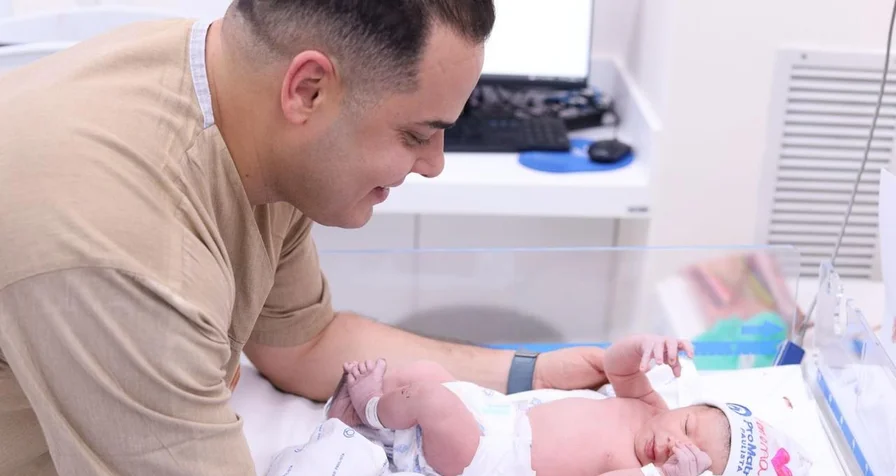
You’re asleep on my chest as I write this. You’re a few months old, breathing fast, and you have no idea yet that there’s a world out there beyond my chest and your mother’s voice.
I’m dating this letter to 2044. You’ll be 18 when you read it — the age at which I swore I already understood the world, and look how wrong I was. I’m writing now, in 2026, because one day I want you to know exactly what your father imagined about the world you’d find, back when that world was still just a bet.
And this isn’t loose guesswork. It’s what I genuinely believe, looking at what’s already being built today and pulling the lines forward. I’ll get plenty wrong — how long each thing takes, the details, maybe the whole direction. Some of these lines you’ll read laughing at how naïve I was, and that’s fine. What I don’t want to get wrong is what sits underneath them.
I’ve seen a lot change
I was born in 1988. Let me tell you about the world I grew up in, because you won’t believe it.
I saw the internet arrive. The real one, the kind that tied up the phone line and made a sound like a choking robot to connect. I saw tube televisions, those heavy monsters of curved glass that warmed up the whole room. I got my first smartphone as an adult — a Google Nexus — and I remember the feeling of holding the entire world in the palm of my hand for the first time.
I lived through a pandemic that stopped the planet and sent the whole world indoors. And, shortly before we decided to have you, I watched something called ChatGPT show up and talk to me like a person. And I’ve worked with technology my whole life — yet it still knocked me off balance. It felt like magic. It felt too soon.
That was a lot for one lifetime. And here’s what keeps me up at night and lights me up at the same time: even after seeing all of that, I’m almost certain the world will change more in your lifetime than it did in mine — and faster. Change doesn’t move in a straight line; it accelerates. The internet took decades to reach everyone. AI had been built quietly for years, but it stormed into everyone’s life in a matter of months.
The world you’ll find
Let’s do the exercise. Close your eyes and imagine Brazil, the world, your 2044.
No one you know drives. Or almost no one. Shortly before you were born, in a single year, more than 37,000 people died on Brazilian roads — the worst number in nearly a decade. Worldwide, it was more than a million people, every year, year after year. We treated it as scenery, as if it were the natural price of getting around. As I write this, Waymo’s self-driving cars already run half a million rides a week across several cities, with no driver, and they’re on track to double that within the year. By the time you read this, driving by hand will be a weekend hobby, something people who enjoy it do for fun. And you’ll look back with the same astonishment I feel today remembering that there was a time when surgeons operated without washing their hands: wait, people steered tons of metal at 100 km/h, tired and distracted — and we accepted tens of thousands of deaths a year as if it were normal? It’ll sound savage. Because it was.
Work will be something else. I’ve written a lot about this: AI stopped merely suggesting and started to do — opening systems, executing entire tasks. Today it still stumbles, still needs people nearby to keep it from crashing; the gap between the demo that dazzles and what survives real life is still wide. But the direction is clear. In your world, having a team of digital agents handling tasks will be as ordinary as having email was for me. And repetitive physical work follows the same path: the first humanoid-robot factories are already coming off the drawing board, with promises — still unproven — to build them by the millions. None of this means a world without work. It means a world where the value shifts from executing to deciding what’s worth doing. But that shift won’t be fair or automatic: many people will be left behind along the way, and part of your job, my girl, will be refusing to pretend those people don’t exist.
Energy will be almost free. That sounds like a technical detail, but it might be the most profound change of all. As I write this, solar power has just become the cheapest source of electricity in human history — it dropped 90% in price in fifteen years, and batteries fell nearly as much. Combine cheap, abundant energy with cheap, abundant intelligence, and you get a combination that changes the very nature of the economy. Desalinating water, manufacturing, computing, transporting: everything that’s expensive today because it consumes energy and labor tends to plummet in price. But “cheap” isn’t “free” — the easier it gets to spend energy, the more the world invents ways to spend it, and AI’s own brains already compete for electricity with entire cities. The world’s bottleneck stops being producing things and becomes deciding which things deserve to exist — and how much of the planet we’re willing to burn on them.
The black box in your hand will disappear. Today I spend hours a day staring at a rectangle of glass, and I’m not proud of it. You probably won’t have that rectangle. The big companies are already betting that, by your teenage years, an ordinary pair of glasses will do what the phone does today — information becomes a transparent layer over the real world, instead of a hole you escape the real world through. Maybe that gives you back your gaze, lifted up. Or maybe it just makes the distraction even more invisible. Honestly, I don’t know, and that’s one of the things that worries me most.
Medicine will play a different game. Right now, drugs that started out for diabetes are already showing signs of slowing biological aging itself, and serious scientists are debating whether your generation might be the first to push life expectancy well past a hundred — at least for those who can afford it. There are already people with paralysis controlling computers with thought alone, through a chip in the brain. By the time you read this, the line between body and machine will be far blurrier than it is today. You may live much longer than I will — and, because of that, have not one career but five or six different professional lives along the way.
Notice the connection between all these lines, because this is where the non-obvious lives: the cheaper the answer gets, the more expensive the question becomes. The more realistic the imitation gets, the more valuable authenticity becomes. The more the world automates the doing, the more everything comes to depend on deciding what to do. That thread is what leads me to the part of this letter that matters most.
What I’m betting won’t change
Guessing the scenery is the easy part, and the part that ages fastest. Now comes the part where I really place my bet — on what I believe will keep its worth in a world where almost everything I described above has become a commodity. These aren’t rules. They’re the things I wish I’d understood sooner, and that no machine will learn in your place.
The first is knowing which question to ask. In a world where any answer is instant, free, and infinite, all the value migrates to the question. Defining the right problem, seeing what no one else saw, realizing that the question everyone is asking is the wrong one — no machine does that for you, because it depends on wanting something. The rarest skill of your time won’t be finding answers; it’ll be knowing what’s worth asking.
Out of the question grows the second: judgment and taste. When producing anything becomes trivial, deciding what’s good becomes priceless. Choosing, among a thousand equally possible options, which one is actually worthwhile — that’s taste, that’s discernment, that’s formed judgment. And judgment can’t be downloaded from anywhere: it’s built by living, by getting things wrong, by paying attention. Cultivate yours. It’ll be your edge when doing is no longer anyone’s edge.
You’ll need that judgment above all for one thing: trusting in a world of imitations. In your era, text, voice, and video indistinguishable from the real thing will be abundant and cheap. Any face can say anything; any voice can be forged. In that ocean of perfect imitation, the scarcest and most valuable thing becomes knowing whom to trust. Reputation, integrity, keeping your word — what people used to call character — stop being merely a moral virtue and become, also, a practical advantage. People will seek you out not for what you know, which will be within everyone’s reach, but for being able to trust you.
And amid all that simulation, don’t lose what’s real: true presence. The more the world turns into screens, simulation, and artificial company, the rarer and more precious the simple act of truly being with someone becomes. Looking someone in the eye, listening without rushing, holding a hand. Technology will offer you a thousand convincing substitutes for human presence. Don’t accept them all. What heals, what sustains, what gives meaning, is still people — and that, I’d bet, won’t change in 2044 or in 2144.
And if everything changes too fast, the last bet is the one that holds up all the others: the courage to start from scratch. If you’re going to live several professional lives, what carries you isn’t mastering one thing. It’s the courage to begin again — to question how things are done, to think from first principles instead of copying what already exists, to disagree when agreeing is easier. I never liked people who only say “yes sir,” and I hope you won’t be that way either, not even with me. In a world that changes fast, adapting again and again is worth more than any certainty you hold at 18.
Before I let you go
I’m ending this letter with two feelings wrestling inside my chest.
One is excitement. You’ll see things I can barely imagine, solve problems that seemed impossible to me, live longer and freer from manual labor than any generation before yours. What a privilege to begin life now.
The other is worry. All that power comes with shadows — the distraction engineered to capture you, the imitation that blurs the real, the temptation to outsource the thinking, the feeling, the deciding to a machine. I’ve seen enough to know that no technology arrives with only its good side, and that anyone who tells you they know how all of this ends is selling you something.
But if there’s one thing I won’t give up on, it’s this: I don’t know what world will be waiting for you, but, as your father, I’ll do my best to prepare you for whatever world comes. Not by handing you ready-made answers, which will be stale before you grow up, but by helping you build what doesn’t age — the judgment, the courage, the character, and the capacity to truly love.
And if you reach 18 and none of this matches who you are — if you choose a path I never dreamed of, or prove your father wrong from beginning to end — that’s fine too. I didn’t write this for you to become my bet. I wrote it so you’d know that someone, from the very first day, was rooting for you to become you.
With love, your father — in 2026, writing to you in 2044.
Join my Newsletter
Thoughts on technology leadership, AI, and education. Straight to the point, no fluff.
No spam. Unsubscribe anytime.