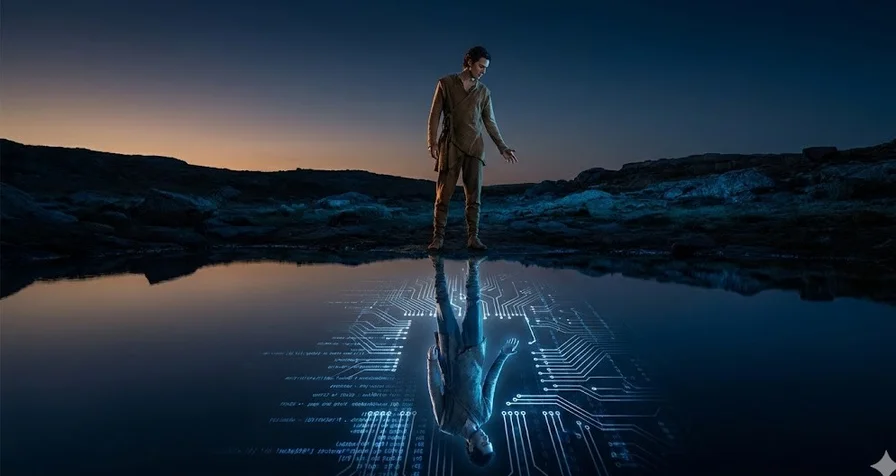
It's not about AI replacing you. It's about what remains when it does what you do.
By the end of 2026, AI will operate computers like humans. The question isn't whether it will replace tasks, it's what remains of you when it does.
This week I read an article by Peter Diamandis that stopped me in my tracks. The piece, based on a three-hour conversation with Elon Musk, makes a prediction that sounds like science fiction but is becoming increasingly hard to ignore: by the end of 2026, AI will be able to operate a computer like a human. Not assist. Not suggest. Do. Open systems, navigate interfaces, execute complete tasks. Start to finish, without supervision.
That made me rethink a few things.
What changes when AI does, not just suggests
Most people still think of AI as a glorified autocomplete. You type a question, it answers. You ask for a text, it generates one. It’s useful, but it’s still reactive. You’re in control.
The shift that’s coming is different. Geoffrey Hinton has already warned that replacement goes far beyond call centers and repetitive tasks. Forrester called 2026 “the year of agents”, meaning AI systems that don’t wait for commands but take initiative. At CES 2026, companies demonstrated digital clones of employees capable of autonomously executing entire work routines.
What does this mean in practice? It means that analyst who spends the day extracting data from a system, formatting spreadsheets, and building reports could have their entire routine replicated by an agent. Not partially. Entirely. AI stops being a tool and becomes an operator.
Thinking from scratch in a world that copies answers
The Diamandis article includes an example that stuck with me: when SpaceX decided to build the Starship, Elon Musk questioned the basic premise that rockets need to be made of carbon fiber. He went back to fundamentals, did the math, and concluded that stainless steel was better in almost every way. Cheaper, more heat-resistant, easier to work with. Everyone in the industry thought it was absurd. It worked.
This is first principles reasoning: instead of accepting how things are done, asking why they’re done that way. And whether they should be done differently.
Now connect this to the AI landscape. Most companies are trying to fit AI into old processes: automate a step here, speed up another there. When the right approach would be to rethink processes from scratch. If AI can do 70% of what an analyst does (McKinsey’s estimate), the question isn’t “how do I protect the role.” It’s “what should exist in its place?”
What remains is what matters
When AI takes over the tasks, what remains? Judgment. Context. Creativity. The ability to define the right problem before seeking the solution.
Think about the calculator. When it became widespread, many thought mathematicians would become irrelevant. The opposite happened: calculators eliminated the mechanical part and freed mathematicians to focus on what truly matters: thinking. What changed wasn’t the profession, but what it meant to be a mathematician.
With AI, something similar is happening, but at a much larger scale. It won’t eliminate professionals. It will radically change what it means to be a professional. The mechanical work (filling in, formatting, copying, organizing) will be absorbed. What stays is the part no machine replicates well: understanding nuance, navigating ambiguity, asking questions no one thought to ask.
The most valuable skill stops being doing. It becomes deciding what to do.
And this is where first principles thinking makes all the difference. Those who think from fundamental premises will adapt because they know how to rebuild from scratch. Those who only follow processes will compete with machines that follow processes infinitely better.
The direction is clear
I don’t know if these predictions will materialize on the timeline they claim. Technology predictions tend to get the timing wrong, sometimes too early, sometimes too late. But the direction seems clear to me.
The question that remains is simple: what are you doing today that an AI couldn’t emulate tomorrow? And if the answer is “almost everything”, maybe that’s not a reason for panic, but it is a reason to rethink. Rethink what you do, why you do it, and most importantly what only you can do.
Because in the end, it’s not about AI replacing people. It’s about what you do when it replaces tasks.
If this topic interests you, I’d love to exchange ideas. Find me on LinkedIn.
Join my Newsletter
Thoughts on technology leadership, AI, and education. Straight to the point, no fluff.
No spam. Unsubscribe anytime.